Code as Literature.
Lish is the first programming language designed to be read like a story and written like a letter. We believe that syntax should not be an obstruction to thought, but an elegant carriage for logic.
Natural Syntax
Code that reads exactly as English. Eliminate the cognitive load of deciphering symbols; let the logic speak for itself.
Logical Flow
Structured like a well-reasoned essay. Functions are chapters, variables are subjects, and execution is the narrative arc.
The Author's Compiler
A compiler that acts as an editor, suggesting structural improvements and enforcing clarity rather than just catching syntax errors.
to find the average of numbers,
    let the sum be zero,
    for each number in numbers
        add the number to the sum,
then return the sum divided by the count of numbers.// Why Lish?
A New Era of General-Purpose Design
Lish was built because modern developers shouldn't have to choose between cognitive comfort and execution speed. Here is how Lish stacks up against standard general-purpose languages.
Intuitive Syntax
No cryptic symbols, semicolons, or nested parentheses. Lish reads like plain English instructions, making the code self-documenting.
Zero-Cost Abstractions
High-level structures like entities and component systems map directly to contiguous memory arrays and flat offsets at build time.
Elegant Simplicity
No heavy runtimes, no complex package config. A clean, single-binary compiler toolchain that gets out of your way and runs anywhere.
Native Machine Speed
Compiles directly to zero-overhead x64 machine code with advanced CPU register mapping and vector optimizations.
// Interactive Site Snapshots
The Aesthetic Design Canvas
Here are the original, visually stunning, high-fidelity design concepts for the Lish homepage and Lexicon reference.
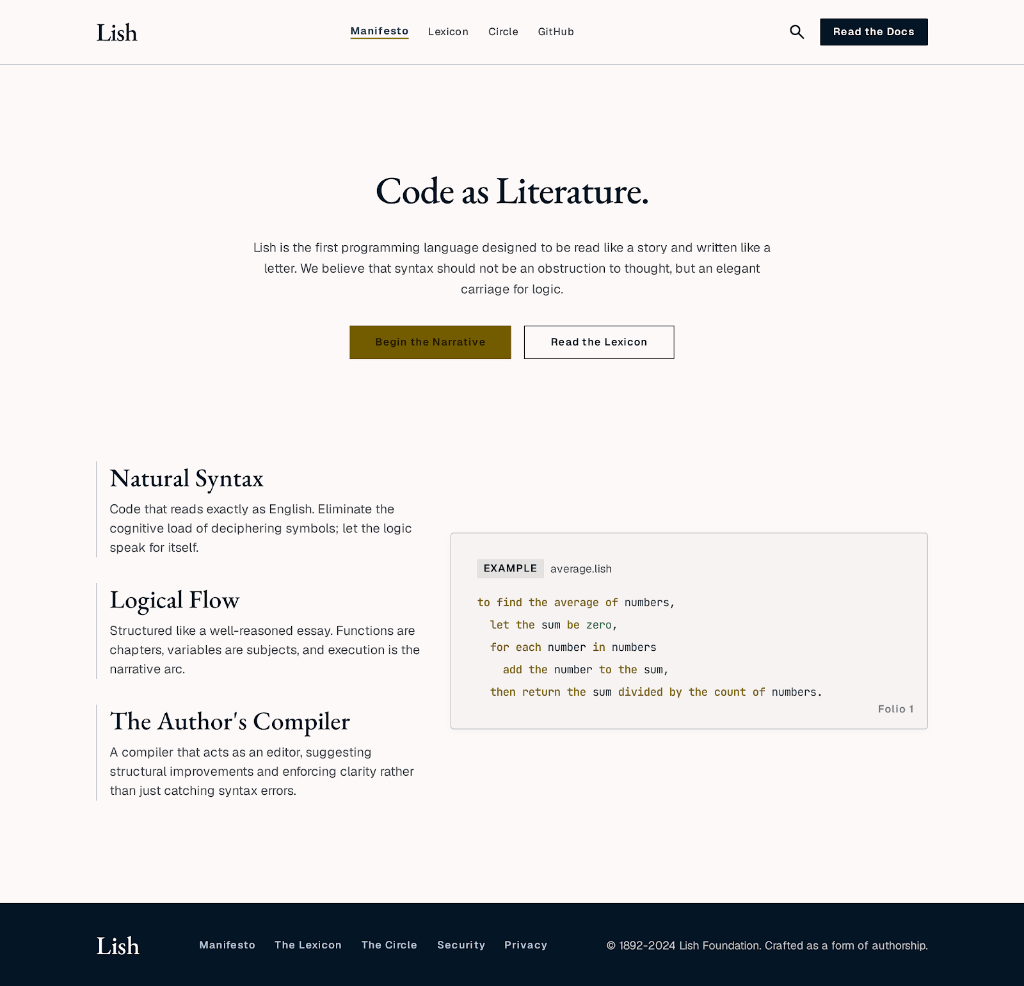
Design Concept: Home & Manifesto
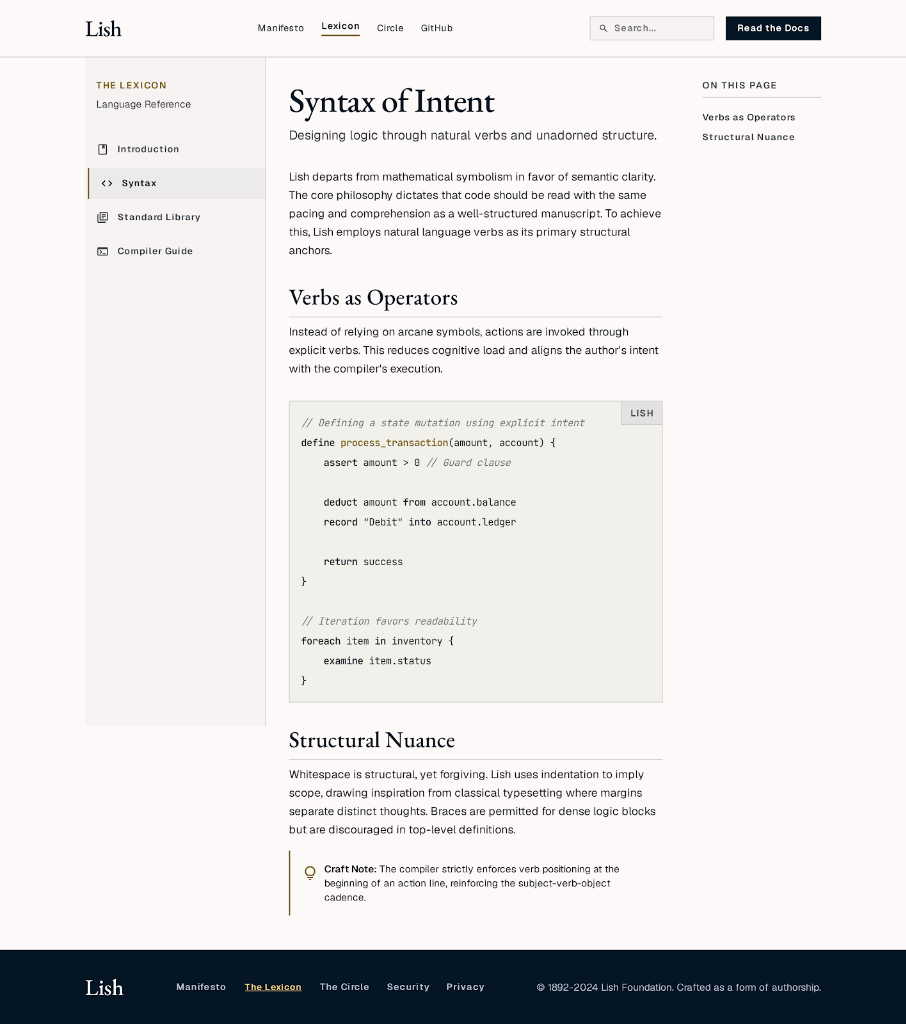
Design Concept: Syntax of Intent
Technical Lexicon Specification
1. Basics
Declaring variables, console printing, and basic arithmetic. Types are inferred automatically.
// Hello World
say "Hello World"

// Variables & Inference
let name be "Alex"
let age be 25

say name
say age

// Math & Operations
let a be 10
let b be 20
let result be a + b
say result